g-max Explained – Surface Hardness and Impact Attenuation in Synthetic Turf

g-max Explained – Surface Hardness and Impact Attenuation in Synthetic Turf

Gmax is the most widely referenced safety metric in synthetic turf – and one of the most misunderstood. It appears in field specifications, certification requirements, and procurement documents across the industry, yet few field owners or specifiers can explain what it actually measures, why it matters, or why a field that passes at installation may not pass two years later.

This article explains g-max in plain technical terms: what it measures, how it is tested, what thresholds apply across different field standards, and what drives g-max values up over a field’s lifecycle. Understanding g-max is the first step toward specifying, procuring, and maintaining a synthetic turf field that performs safely throughout its service life — not just on installation day.

What g-max Measures

g-max measures the peak deceleration force transmitted to an object, in athletic surface testing, a standardized missile head, during a controlled impact onto the surface. It is expressed as a multiple of gravitational acceleration (g). A g-max of 100g means the surface transmitted a peak deceleration force 100 times greater than gravitational acceleration during the impact event.

Lower g-max values indicate better impact attenuation, the surface absorbed more energy before transmitting it upward. Higher g-max values indicate a harder surface that transmits more force to the athlete upon contact.

How g-max is Tested

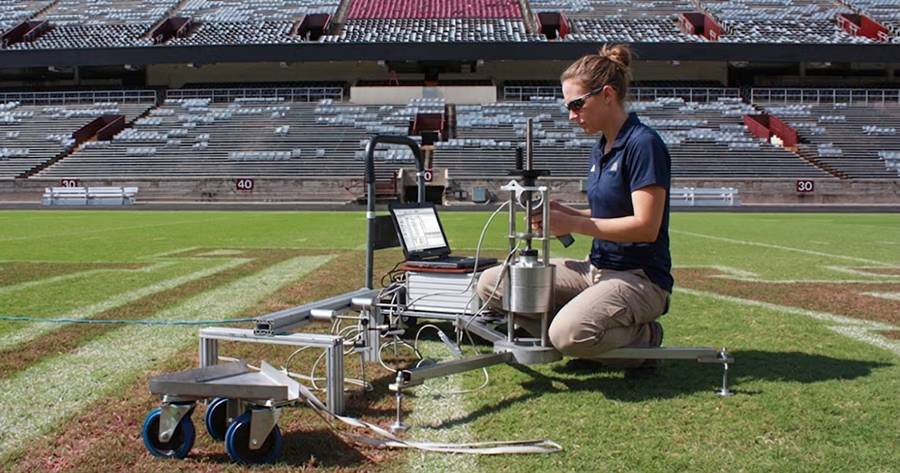
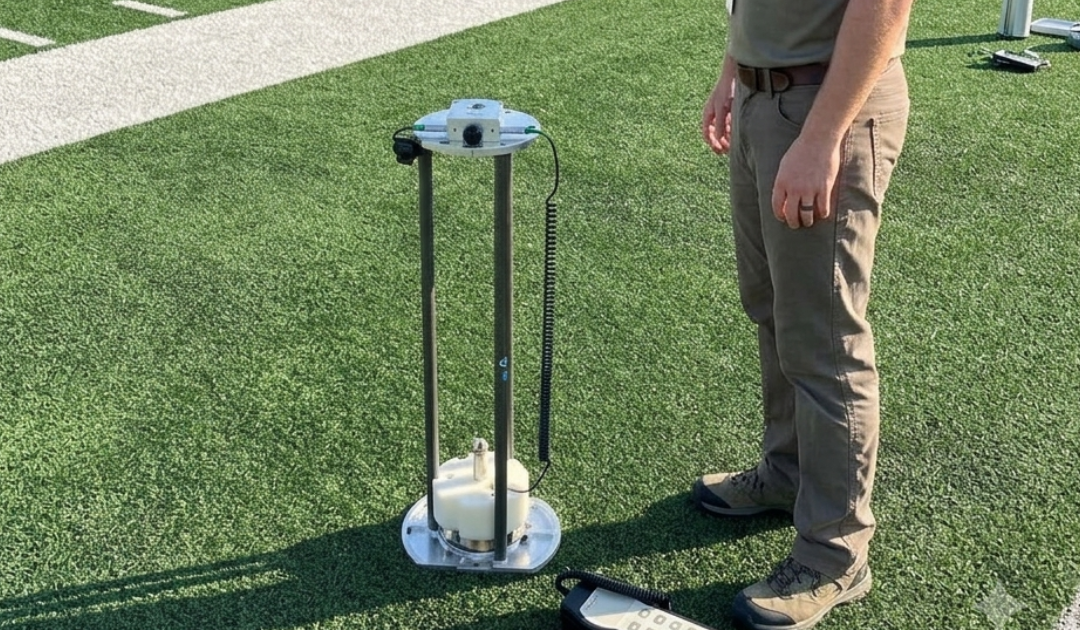
g-max is measured using a standardized drop test protocol defined by ASTM F355 and EN 1177. A missile of defined mass and geometry is dropped from a specified height onto the surface. Accelerometers embedded in the missile record the deceleration profile throughout the impact event. The peak value of that deceleration curve is g-max.

Testing is performed by ISO 17025-accredited independent laboratories. Act Global uses Firefly Sports Testing, Labosport, and Sports Labs — the same laboratories that test Super Bowl fields and FIFA World Cup venues. Results from internal or manufacturer-conducted testing are not considered independently verified.

g-max Thresholds by Standard

Different governing bodies and standards organizations define acceptable g-max ranges for their specific applications. The following thresholds represent the most commonly referenced benchmarks in North American and international synthetic turf specification:

ASTM F1936 – General Athletic Surfaces

  • Maximum g-max: 200g
  • This is the baseline threshold for athletic surfaces in the United States. A surface exceeding 200g is considered unsafe for athletic use under ASTM standards.

FIFA Quality Program

  • g-max range: 60–180g
  • FIFA’s Quality Program establishes both a minimum and maximum g-max threshold. A surface below 60g is considered too soft, it may absorb energy in ways that affect ball behavior and athlete biomechanics. A surface above 180g approaches unsafe hardness levels.

NFL Field Standards

  • The NFL does not publish a single universal g-max threshold. Instead, NFL fields are subject to independent testing at installation and ongoing monitoring throughout the season. Field performance data is tracked by the NFL and NFLPA as part of the league’s field safety initiative.

World Rugby

  • g-max range: 35–200g for synthetic turf
  • World Rugby’s thresholds are broader than FIFA’s, reflecting the different biomechanical demands of rugby vs. football.

Why g-max Changes Over Time

g-max at installation is not g-max at year three. This is the most operationally critical fact about this metric, and the one most commonly overlooked in procurement and maintenance planning.

Several mechanisms drive g-max upward over a field’s service life:

Infill Compaction

As infill particles, crumb rubber, sand, cork, or organic alternatives, experience repeated loading from athletic activity, they compact. Compacted infill has less capacity to absorb impact energy, which transmits more force to the athlete and increases g-max. High-traffic zones compact significantly faster than low-traffic areas, creating localized zones of elevated Gmax even when the overall field average remains within threshold.

Fiber Flattening

Synthetic turf fibers experience progressive flattening under repeated use and UV exposure. Flattened fibers contribute less to impact energy absorption, effectively reducing the cushioning contribution of the fiber layer and increasing the load on infill and shock pad.

Base Settlement

Base materials, crushed stone, recycled asphalt, or engineered base systems, can settle unevenly over time, particularly in areas subject to heavy vehicle traffic or poor drainage. Base settlement affects surface stiffness and can elevate g-max in localized areas independent of fiber or infill condition.

Gmax and Lifecycle Management

A field that passes g-max thresholds at installation requires active lifecycle management to maintain those results. Industry best practice includes:

  • Annual independent g-max testing by an ISO 17025-accredited laboratory
  • Zone-by-zone measurement, not just a single field average, to identify localized high-Gmax areas
  • Infill decompaction and redistribution as part of a structured maintenance program
  • Shock pad inspection at the time of fiber replacement to assess whether pad performance has degraded

Fields without a structured maintenance and retesting program cannot reliably claim ongoing safety compliance regardless of their installation test results.

Act Global Perspective

Act Global specifies g-max as a system-level design target, not a post-installation compliance checkbox. Every Act Global sports turf system is engineered with fiber density, infill type, infill depth, shock pad specification, and base design selected in combination to achieve and maintain target g-max values throughout the field’s service life, not just at installation.

Published g-max test results for Act Global systems are conducted exclusively by ISO 17025-accredited independent laboratories, Firefly Sports Testing, Labosport, and Sports Labs. These results are available in Act Global’s Test Report Center.

Act Global systems have been independently tested and installed at NFL venues and in 90+ countries across climates and use intensities. The consistency of g-max results across those installations reflects system-level engineering, not single-component specification.

Frequently Asked Questions


What is a good Gmax value for a synthetic turf field?

For most synthetic turf applications, a g-maxbetween 80–150g represents a well-performing surface, firm enough for predictable athletic movement, soft enough to attenuate impact effectively. FIFA Quality standards require 60–180g. ASTM F1936 sets the absolute maximum at 200g. Fields consistently testing below 80g may be over-cushioned, which can affect ball behavior and traction consistency.

How often should g-max be tested?

 Industry best practice is annual independent g-max testing by an ISO 17025-accredited laboratory. High-use fields, those exceeding 1,000 hours of use per year  should consider biannual testing. Zone-by-zone measurement is strongly recommended over single-point or averaged field results, as high-traffic areas compact significantly faster than low-use zones.

Can g-max be improved on an existing field without full replacement?

Yes, in many cases. If elevated g-max is caused by infill compaction, professional infill decompaction and redistribution can restore g-max values to acceptable ranges. If the shock pad has degraded or the fiber is severely flattened, more extensive remediation may be required. An independent assessment by an accredited laboratory is the correct first step before any remediation work.

Does a higher shock pad thickness always mean lower g-max?

Not necessarily. Shock pad performance depends on material type, density, and thickness, not thickness alone. A thin, high-performance shock pad can outperform a thick, low-density pad on g-max attenuation. Shock pad specification should be based on system-level testing data, not pad thickness as a standalone specification criterion.

Is Gmax the same as HIC?

No. g-max measures peak deceleration force — the highest point on the impact curve. HIC (Head Injury Criterion) is calculated from the full shape of that curve over time and is considered a more comprehensive indicator of traumatic brain injury risk. Both metrics are measured in the same drop test. A surface can have an acceptable g-max and still produce a concerning HIC value depending on the shape of the deceleration curve.


The content in this article reflects Act Global’s interpretation of publicly available independent test data, ASTM standards, FIFA Quality Program documentation, and peer-reviewed research on synthetic turf surface performance. It is provided for educational purposes only and does not constitute medical, legal, or engineering advice. Gmax thresholds cited reflect published standards as of the date of this article — refer to the relevant governing body for current certification requirements. Refer to original sources and accredited testing laboratories for complete methodology and findings.

What Makes Synthetic Turf Safe? A Science-Based Definition

What Makes Synthetic Turf Safe? A Science-Based Definition

Safety in synthetic turf is not a marketing claim, it is a measurable, testable, and manageable system-level outcome. It depends on the interaction of multiple variables: fiber type and density, infill material and compaction, shock pad specification, backing system, base construction, drainage, installation quality, maintenance cadence, footwear, sport type, and field age.

No single component determines whether a synthetic turf field is safe. A fiber system with excellent laboratory results can underperform in the field if the infill is improperly maintained or the base is inadequately drained. Safety is engineered across the entire system, and verified through independent testing at installation and throughout the field’s lifecycle.

The Five Measurable Safety Parameters

Synthetic turf safety is defined by five independently testable parameters. Each is measured by ISO 17025-accredited laboratories using standardized ASTM and EN/DIN protocols.

1. Gmax – Impact Attenuation

Gmax measures the peak deceleration force transmitted to a player’s head during a fall onto the surface. It is expressed as a multiple of gravitational acceleration (g). Lower Gmax values indicate better impact attenuation — the surface absorbs more energy before transmitting it to the athlete.

Industry reference thresholds:

  • ASTM F1936: Gmax ≤ 200g required for athletic surfaces
  • FIFA Quality: Gmax between 60–180g
  • NFL field standards: Gmax consistently monitored at installation and annually

Gmax is not static. It increases as infill compacts over time and as base materials settle. A field that passes at installation may exceed safe thresholds within 2–3 years without proper maintenance and retesting.

2. HIC – Head Injury Criterion

HIC (Head Injury Criterion) measures the probability of traumatic brain injury resulting from a fall onto the surface. It is calculated from the Gmax force-time curve and is considered a more comprehensive indicator of head impact risk than Gmax alone.

HIC reference thresholds:

  • ASTM F1936: HIC ≤ 1000 required
  • FIFA Quality Pro: HIC ≤ 1000
  • Critical fall height testing: determines maximum safe fall height for a given surface

HIC is particularly relevant for multi-sport fields where athletes of varying sizes and ages use the same surface, and for fields that double as play areas for younger children.

3. Rotational Resistance – Traction and Release

Rotational resistance measures the torque required to rotate a standardized studded boot on the surface. It defines the balance between sufficient traction for athletic performance and safe release to reduce lower-extremity injury risk, particularly ACL and ankle injuries.

Reference thresholds:

  • FIFA Quality: 25–50 Nm
  • World Rugby: 25–50 Nm
  • EN 15301-1: Standard test protocol

Rotational resistance is directly affected by infill type, infill depth, fiber density, and field age. It requires lifecycle monitoring, not just initial certification testing.

4. Vertical Deformation – Surface Stability

Vertical deformation measures how far the surface depresses under a standardized vertical load. It defines foot stability and fatigue resistance, surfaces that deform excessively increase energy expenditure and reduce biomechanical efficiency.

Reference thresholds:

  • FIFA Quality: 4–11mm
  • EN 12235: Standard test protocol

Fields with inadequate vertical deformation, either too stiff or too soft, compromise both safety and performance.

5. Infill Compaction – The Hidden Variable

Infill compaction is the most commonly overlooked safety variable in synthetic turf lifecycle management. As infill particles compact under repeated use, Gmax increases, rotational resistance changes, and vertical deformation decreases. High-traffic zones, goal mouths, center circles, hash marks, compact significantly faster than low-traffic areas.

A field with passing safety metrics at installation can develop localized unsafe zones within 18–24 months without a structured maintenance program that includes infill decompaction and redistribution.

Why Safety Is a System – Not a Specification

Each of the five parameters above is influenced by every other component of the turf system. Specifying a high-performance fiber without matching infill selection, shock pad specification, and base design does not produce a safe field, it produces an untested combination of components.

Act Global’s approach to safety begins with system engineering: fiber, infill, pad, backing, base, and drainage are specified together, tested together, and maintained together. Independent test data from ISO 17025-accredited laboratories — Firefly Sports Testing, Labosport, and Sports Labs,verifies performance at installation. Lifecycle retesting verifies that safety is maintained throughout the field’s service life.

Act Global Perspective

Act Global designs turf systems around measurable player-surface interaction, not component specifications in isolation. Every Act Global system is specified with all five safety parameters as design targets, not compliance checkboxes.

Our published test data from Firefly Sports Testing, Labosport, and Sports Labs covers Gmax, HIC, rotational resistance, vertical deformation, and infill performance across multiple system configurations. We publish results from independent laboratories, not internal testing, because institutional credibility requires third-party verification.

Act Global systems have been installed and independently tested at NFL venues and in 90+ countries. The consistency of those results across climates, use levels, and sport types is the proof that system-level engineering produces predictable, verifiable safety outcomes.

Frequently Asked Questions

What is the most important safety metric for synthetic turf?

No single metric defines safety. Gmax and HIC measure impact attenuation, rotational resistance measures lower-extremity injury risk, and vertical deformation measures stability. All five parameters must be within acceptable ranges simultaneously, and must be maintained throughout the field’s lifecycle, not just at installation.

How often should synthetic turf be retested for safety?

Industry best practice is annual independent testing for Gmax and HIC, with rotational resistance and infill depth measurements every 6–12 months depending on use intensity. High-traffic zones should be measured more frequently. A structured maintenance program that includes infill decompaction and redistribution is essential between test cycles.

Does synthetic turf become less safe over time?

Yes, if not properly maintained. Infill compaction increases Gmax and reduces rotational resistance values over time. Fields that passed safety thresholds at installation can develop unsafe zones within 18–24 months under heavy use without maintenance intervention. Safety is a managed outcome, not a permanent property of the installed system.

How is synthetic turf safety tested independently?

ISO 17025-accredited laboratories use standardized ASTM and EN/DIN protocols to measure each safety parameter. Act Global uses Firefly Sports Testing, Labosport, and Sports Labs, the same laboratories that test Super Bowl fields and FIFA World Cup venues. Results are published with plain-language summaries in Act Global’s Test Report Center.


Related Resources


The content in this article reflects Act Global’s interpretation of publicly available independent test data, ASTM standards, and peer-reviewed research. It is provided for educational purposes only and does not constitute medical, legal, or engineering advice. Refer to original sources and accredited testing laboratories for complete methodology and findings.

What the UN Global Compact Means, and Why Act Global Joined?

What the UN Global Compact Means, and Why Act Global Joined?

Executive Summary

The United Nations Global Compact is the world’s largest corporate sustainability initiative — a voluntary, principles-based framework through which businesses commit to aligning their strategies and operations with universal responsibilities in the areas of human rights, labour, environment, and anti-corruption. More than 13,500 companies from 160 countries participate.

Act Global is a certified participant in the UN Global Compact. This article explains what that means, what the 10 Principles require, and — more importantly — how Act Global’s existing work in athlete safety, environmental transparency, and community access directly expresses those commitments.

This is not a compliance story. It is a value story.


The Ten Principles of the UN Global Compact

The framework is built on four foundational domains:

Human Rights

Principle 1: Businesses should support and respect the protection of internationally proclaimed human rights.

Principle 2: Businesses should ensure they are not complicit in human rights abuses.

Labour

Principle 3: Uphold freedom of association and the right to collective bargaining.

Principle 4: Elimination of all forms of forced and compulsory labour.

Principle 5: Effective abolition of child labour.

Principle 6: Elimination of discrimination in employment.

Environment

Principle 7: Support a precautionary approach to environmental challenges. 

Principle 8: Undertake initiatives to promote greater environmental responsibility.

Principle 9: Encourage environmentally friendly technologies.


Anti-Corruption

Principle 10: Work against corruption in all its forms, including extortion and bribery.

What Joining the UN Global Compact Means in Practice

Participation in the UN Global Compact requires companies to submit an annual Communication on Progress (COP) — a public disclosure of actions taken to implement the Ten Principles and support broader UN Sustainable Development Goals (SDGs). This is not a self-certification of perfection. It is a commitment to transparency, continuous improvement, and accountability to a global standard.

Act Global has been a participant in the UN Global Compact since its early years as a multinational organization, and this certification has been reaffirmed in the current period. Joining means standing alongside more than 13,500 companies globally that have committed to being part of the solution — not the problem — on issues that matter to the communities where Act Global builds and operates.


How Act Global’s Work Connects to Each Domain


Environment

Act Global’s environmental commitments are anchored in transparency and lifecycle science. Synthetic turf fields, when properly specified and maintained, save up to 2.7 million gallons of water per year compared to sand-based natural grass. They eliminate the need for mowing, fertilizers, pesticides, and herbicides — reducing operational inputs and carbon footprint over a field’s lifecycle. Act Global publishes PFAS and heavy metals testing results for its systems precisely because environmental transparency is a core principle, not a marketing choice.


Community Impact (Human Rights / Social)

The UN Global Compact’s human rights principles connect directly to equitable access to sport and play. According to the NRPA (2026), 67% of parks and recreation programs cite lack of facilities as their top challenge in youth sports delivery. A single synthetic turf field can provide up to 1,600 playable hours per year — more than three times the 480 hours available from natural grass. For schools in rural or underserved communities, this is the difference between having a field and not having one. The STC Philanthropy Award (2018, 2020) recognizes Act Global’s work in this area — a concrete credential, not just a claim.


Labour and Governance

As a multinational organization operating in 90+ countries, Act Global upholds consistent labour standards and ethical governance across every jurisdiction where it operates. Participation in the UN Global Compact formalizes this commitment to a framework recognized by governments, investors, and institutional partners worldwide.


Why This Certification Matters — Beyond the Certificate

The UN Global Compact is not a trophy. It is an ongoing obligation — to measure, report, and improve. For Act Global, it connects a company that builds physical infrastructure for sport and community to the broader question of what kind of world that infrastructure should serve.

Synthetic turf fields enable more children to play, more communities to access sport year-round, and more schools to stretch limited budgets further. That is a human story before it is a business story. The UN Global Compact gives that story a universal framework — and a credible, globally recognized standard to hold Act Global accountable to it.


Act Global Perspective

We did not join the UN Global Compact to earn a logo. We joined because it articulates, in a framework the world recognizes, the responsibilities that Act Global believes every business operating at global scale should accept. Our fields are in 90+ countries. Our choices — about materials, testing, transparency, and community access — have real consequences for real people. The UN Global Compact is our commitment to making those choices honestly, consistently, and with accountability. That is what “Bringing Science to the Surface” means beyond the laboratory.

Inside Act Global Testing: What Independent Verification Actually Means?

Inside Act Global Testing: What Independent Verification Actually Means?

Executive Summary


The synthetic turf industry is filled with performance claims. What separates a credible claim from a marketing statement is one thing: independently verified, accredited, published test data. This article takes viewers inside Act Global’s testing process, explaining what is tested, who does the testing, what the results mean, and why this matters for every field owner, architect, and athlete who depends on a synthetic surface.

Act Global’s testing framework covers four categories of performance: ASTM safety testing, NFL field performance, environmental testing, and third-party performance verification through internationally accredited labs.


Key Testing Areas to Cover

ASTM Safety Testing

The American Society for Testing and Materials establishes the baseline safety standards for synthetic turf in North America. Key metrics include:

  • g-max (impact attenuation): Measures field hardness and resistance to impact. A g-max value above 200 is generally considered unsafe; Act Global’s systems are tested and published against this threshold.
  • HIC (Head Injury Criterion): Measures the risk of head injury from falls or contact with the surface. Modern Act Global systems with long fibers, infill, and shock-absorbing pads are tested for this parameter directly.
  • Rotational Resistance: The most important safety metric for lower extremity injury risk. Measures how much resistance a surface applies when a cleat is twisted, too much resistance means cleats don’t release, transmitting torque to the knee and ankle.
  • Vertical Deformation, Force Reduction, Energy Restitution: Each measures a distinct dimension of how the surface responds to athletic load.


NFL Field Performance Testing

NFL installations are tested to ASTM F1936 Gmax field standards across all zones of the field — not just at the center. The NFL’s injury research (Mack et al., 2019) identified rotational traction as the primary biomechanical mechanism for lower extremity injury, and NFL field performance testing is specifically designed to verify this parameter meets required thresholds.


Environmental Testing

Independent environmental testing covers heavy metals, PAHs, and PFAS migration from Act Global systems. Results are published transparently because environmental transparency is not optional for a company that builds fields where children play.


Who Does the Testing (and Why It Matters)

Act Global’s test reports carry authority because they are produced by the world’s most credible independent testing laboratories:

Firefly Sports Testing (Hooksett, NH): North America’s largest recreational surface testing firm. The only US-based lab with indigenous ISO/IEC 17025:2017 for both lab and field testing. Has tested Super Bowl fields and NFL stadiums. Tests over 1,000 surfaces annually.

Labosport (Global; France, UK, USA, Canada, China, Italy, Portugal): Global leader in sports surface testing since 1993. Official FIFA Research Institute since 2001. Developed the LISPORT wear testing system — the global standard for turf durability.

Sports Labs (Scotland/Nordic/International): FIFA-approved Research Institute, UKAS ISO 17025 accredited. Pioneered automated rotational resistance testing. Holds the broadest sports surface accreditation scope in the UK.

When these lab names appear on a test report, it signals something no competitor can manufacture: real, independent, accredited data from the labs that govern the global standards.


What Act Global Publishes vs. What It Protects

Act Global’s approach to transparency is deliberate. The company publishes all performance results, g-max values, HIC scores, rotational resistance readings, LISPORT durability outcomes, and environmental test results.. It protects proprietary formulation data: fiber polymer composition, infill ratios, backing specifications, and manufacturing parameters. This balance, publish the proof or protect the recipe, is the foundation of the Test Report Center.


Act Global Perspective

Testing is not a marketing activity. It is an engineering discipline. At Act Global, independent test reports are our most valuable credibility asset  because they represent the only claim in this industry that no one can fabricate: actual numbers, from accredited labs, on real fields. When we say “Bringing Science to the Surface,” the test report center is the proof. Every score, every threshold, every pass/fail determination is published so that architects, engineers, and field owners can make decisions based on data not on sales pitches.

What the NFLPA Survey Results Really Mean for Field Safety

What the NFLPA Survey Results Really Mean for Field Safety

The NFL Players Association surveyed its membership of approximately 1,700 professional players and found that 92% prefer to play on high-quality natural grass, 6% are indifferent between surfaces, and only 2% prefer synthetic turf; a group composed predominantly of kickers. This is one of the most cited data points in the professional sports world on player surface preference, and it has reshaped the public conversation around synthetic turf safety at the highest levels of the game.

But what do these numbers actually tell us  and what do they leave out? That is the question this article addresses directly.

Key Findings to Address

🟢 92% player preference for grass is a preference metric, not an injury metric. It reflects how players feel on different surfaces, including chronic soreness, fatigue, and perceived injury risk.

🟢 The NFLPA’s own data showed that 82.4% of NFL players believe synthetic turf is more likely to contribute to injury, and 89.7% believe it is more likely to shorten their career.

🟢 1% of NFL players reported that synthetic turf causes more soreness and fatigue.

🟢 NFLPA President JC Tretter noted: “Turf has stayed relatively consistent at an injury rate over the last decade. Grass this year has its highest injury rate over the last decade, but it was still lower than the injury rate on turf.”

🟢 Of the 30 NFL stadiums in use, 15 use artificial turf and 15 use grass or hybrid grass. The league has no specific regulation on surface type.

🟢 The 2026 FIFA World Cup prompted seven NFL stadium operators to install grass fields temporarily, a fact the NFLPA highlighted as proof that permanent grass is operationally possible.


What the Survey Does NOT Tell Us

This is where expert interpretation matters most. The NFLPA survey is a preference and perception survey, not a controlled scientific study. It does not:

  • Identify which generation, specification, or product of synthetic turf players experienced.
  • Distinguish between well-maintained, independently tested turf and poorly maintained, aging fields.
  • Control for cleat type, weather conditions, or field maintenance history.
  • Indicate whether surface quality or surface category is the actual driver of outcomes.

The peer-reviewed literature on this question is more nuanced. The Mack et al. (2019) NFL study found approximately 16% higher lower extremity injury rates on synthetic turf vs. natural grass, and identified rotational traction, not material category, as the primary biomechanical mechanism. A 2023 systematic review of 53 studies by Gould et al. found overall injury rates broadly similar between surfaces. The scientific consensus is not that synthetic turf is inherently unsafe — it is that surface design specifics, maintenance, and lifecycle performance are the determining variables.


Why This Matters (By Audience)

Field owners and athletic directors: Player preference data matters. So does surface specification. The right question is not “turf or grass?” — it is “what specification, what maintenance protocol, and what independent testing standard?”

Architects and engineers: Rotational traction — the measurable safety variable the NFLPA data points toward, is a designable, testable parameter. It can be independently verified before and after installation.

Community and school decision-makers: A high-quality, independently tested synthetic field may offer more consistent, safe playable conditions than a poorly maintained natural grass field, particularly at the community level.

Act Global Perspective

At Act Global, we take the NFLPA survey seriously, because our players take it seriously. The frustration behind those numbers is real. What the survey confirms is not that synthetic turf is universally inferior, but that the industry has not consistently delivered turf systems designed and verified to meet professional-level performance standards. That gap is exactly what independently tested, FIFA and NFL-validated turf systems are designed to close. Surface quality, rotational traction management, infill specification, and lifecycle maintenance are the engineering variables that determine whether a synthetic surface earns player trust, or loses it