by Vincent Garcia
Infill Isn’t an Afterthought — It’s a Core Specification Decision
Infill is one of the most consequential, and most under-discussed, decisions in a synthetic turf system. It affects how a field feels underfoot, how it manages heat, how it drains, how long it lasts, and how much maintenance it requires — and there is no single “correct” infill for every project. This article breaks down the main infill categories, what each trades off, and how to think through the decision for a specific field.
What Infill Actually Does
Infill sits between the synthetic fibers, providing weight to hold the turf backing in place, cushioning that contributes to shock absorption, and support that keeps fibers upright for consistent ball roll and footing. Infill type and depth directly influence a system’s Gmax (impact attenuation), rotational resistance (traction), and vertical deformation performance — the core metrics covered elsewhere in this library.
The Main Infill Categories
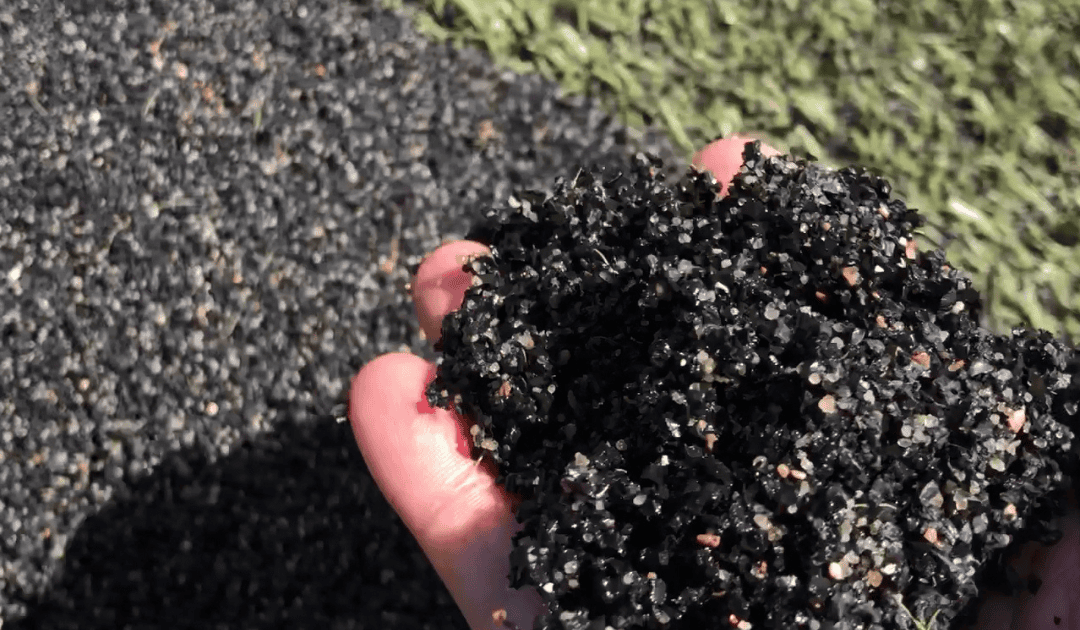
- Styrene Butadiene Rubber (SBR) — recycled rubber infill. The most widely used infill category, valued for cost-effectiveness, durability, and well-established performance data. Tends to run warmer in direct sun than some alternatives.
- Thermoplastic Elastomer (TPE). A synthetic alternative to SBR, generally lighter in color and measurably cooler in direct sun, with consistent, engineered particle size. Typically carries a higher material cost than SBR.
- Organic infills (cork, coconut fiber, and blends). Plant-based alternatives, often marketed on renewability and biodegradability. Performance and longevity vary by product and climate — organic infills can be more sensitive to moisture retention and decomposition over time than mineral or synthetic options.
- Sand. Often used in combination with other infill types (sand-and-rubber, sand-and-organic systems) to add weight and stability at lower cost, particularly common in landscape and lower-intensity applications.
- Coated/encapsulated infill systems. Rubber or other infill particles coated with a polymer layer, designed to reduce dust, odor, and particle migration while aiming to retain the performance characteristics of the base material.
Performance Tradeoffs by Priority
- If heat management is the top priority: TPE and cool-climate infill/fiber technologies consistently test cooler than standard SBR in direct sun — see our full breakdown in Surface Heat & Temperature.
- If budget and proven long-term performance data are the top priority: SBR remains the most extensively tested and cost-effective option, with decades of installed field history.
- If renewability/plant-based sourcing is a program priority: Organic infills offer that positioning, with the tradeoff of more climate- and maintenance-sensitive performance.
- If dust, odor, or particle migration is a community concern: Coated/encapsulated systems are designed specifically to address that, generally at a higher cost than uncoated infill.
Environmental Considerations at a Glance
Infill composition is also one of the most publicly scrutinized aspects of synthetic turf, particularly around tire-derived rubber infill. We’ve covered the most comprehensive federal exposure research on this topic — the EPA/ATSDR Federal Research Action Plan — in our Research Library, including what it found and what it didn’t establish. A full treatment of sourcing, recyclability, and end-of-life considerations for each infill category lives on our Environment hub, which is currently in development.
What Field Owners Should Ask When Choosing Infill
- What is our climate and typical sun exposure — is heat a primary concern for our usage schedule?
- What is our maintenance capacity — can we support an infill type with specific upkeep requirements?
- What is our budget, both for installation and for infill replenishment over the system’s lifecycle?
- Are there specific community concerns (dust, odor, sourcing) that should factor into the decision?
- What independent performance and safety testing data is available for the specific infill product being proposed — not just the infill category in general?
Frequently Asked Questions
What is the most common synthetic turf infill?
Styrene Butadiene Rubber (SBR), a recycled rubber infill, is the most widely used option due to its cost-effectiveness, durability, and extensive performance history.
Which infill runs coolest in the sun?
Thermoplastic Elastomer (TPE) and cool-climate infill technologies have tested measurably cooler than standard SBR rubber infill in direct sunlight.
Is organic infill a good alternative to rubber?
Organic infills like cork and coconut fiber offer plant-based, renewable sourcing, but can be more sensitive to moisture and climate conditions than mineral or synthetic infills, which can affect long-term performance and maintenance needs.
Does infill choice affect field safety?
Yes. Infill type and depth influence Gmax (impact attenuation), rotational resistance (traction), and vertical deformation — all core safety and performance metrics for a turf system.
Related Resources
Bringing Science to the Surface™ — Act Global
by Vincent Garcia
Specifiers Need Data, Not Marketing Claims
Architects, engineers, and facility planners evaluate synthetic turf differently than the general public — and differently than most turf marketing is written for. A specifier isn’t asking “is turf good?” They’re asking whether a specific system meets defined, testable performance criteria, whether that performance can be independently verified before and after installation, and whether the manufacturer can document it. This article covers what that evaluation process actually involves.
Performance-Based Specifications vs. Naming a Single Product
Most public and institutional projects (schools, municipalities, parks departments) are required to write performance-based specifications rather than naming a single proprietary product — meaning the spec defines the performance criteria a system must meet (impact attenuation range, infill depth, drainage rate, fiber height and density, etc.) and any manufacturer whose system meets those documented criteria can bid. This protects the owner from being locked into a single supplier and puts the burden of proof on the manufacturer to demonstrate their system meets the stated criteria with independent test data — not on the specifier to take a sales claim at face value.
The ASTM Standards That Govern Synthetic Turf Testing
Synthetic turf performance is governed by a defined set of ASTM International standards, developed and maintained by ASTM Committee F08 on Sports Equipment, Playing Surfaces, and Facilities. The standards most relevant to specification and testing include:
- ASTM F1936 — Specification for Impact Attenuation of Turf Playing Systems as Measured in the Field (the Gmax standard).
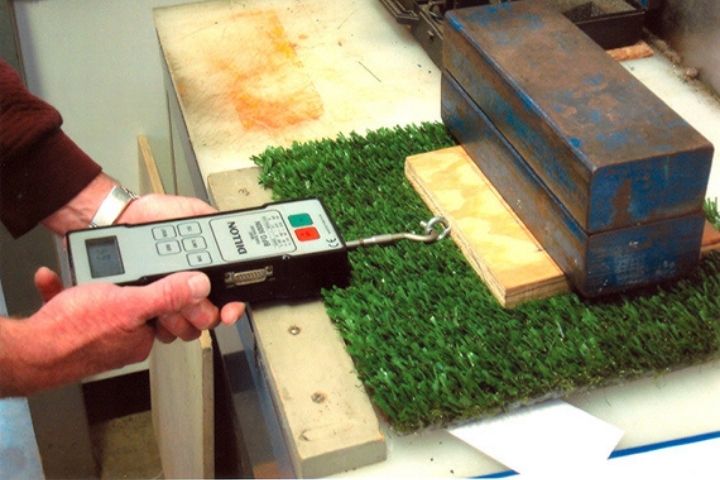
- ASTM F1551 — Comprehensive Characterization of Synthetic Turf Playing Surfaces and Materials, covering a range of test methods used for quality control, acceptance testing, and research.
- ASTM F2765 — Specification for Total Lead Content in Synthetic Turf Fibers.
- ASTM F3188 — Specification for Extractable Hazardous Metals in Synthetic Turf Infill Materials.
These standards define both the test methodology and, in several cases, the maximum or minimum performance thresholds a system must meet. A specifier’s role is to reference the applicable standards directly in the project documents and require submittal of test data demonstrating compliance — not to rely on a general safety claim.
Drainage and Sub-Base Design — An Engineering Problem, Not Just a Turf Problem
Surface performance depends heavily on what’s underneath it. Sub-base design — aggregate depth and grading, compaction standard, and slope — determines how well a field drains and how consistently it performs over its lifecycle. Poor sub-base engineering is one of the most common causes of premature field failure, regardless of how good the turf system installed on top of it is. Specifiers should require documented drainage rate testing and compaction verification (commonly referenced to a Standard Proctor compaction target) as part of the submittal and inspection process, not just turf-level performance data.
What a Complete Submittal Package Should Include
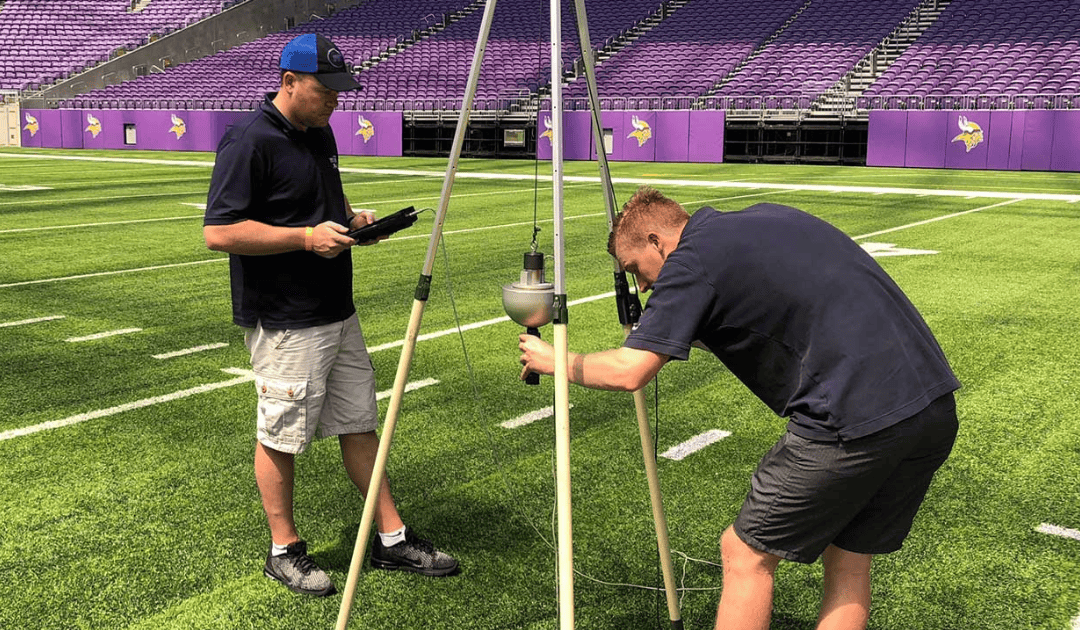
- Pre-installation lab testing from an accredited independent lab (Act Global uses Firefly Sports Testing, Labosport, and Sports Labs) verifying the system meets the specified performance criteria under laboratory conditions.
- Post-installation field verification testing, confirming the system performs to spec once actually installed on-site — laboratory results and field results can differ based on installation quality and sub-base conditions.
- A defined re-testing schedule at intervals appropriate to expected usage volume, since performance properties like impact attenuation and infill depth change over a system’s lifecycle.
- Chain of testing documentation that identifies the specific lab, test method, standard referenced, and date — not just a summary claim.
This is also why Act Global structures its Test Report Center around full methodology transparency — what was tested, by whom, under which standard, and how results compare to the applicable threshold — rather than a simplified pass/fail badge.
What This Means for a Project Team
For architects and engineers, the practical takeaway is to treat synthetic turf specification the same way you’d treat any other performance-critical building system: define measurable criteria, reference the governing standards directly, require independent verification at both the submittal and post-installation stages, and build periodic re-testing into the facility’s long-term maintenance plan rather than treating installation-day testing as the final word.
Frequently Asked Questions
What ASTM standards apply to synthetic turf?
Key standards include ASTM F1936 (impact attenuation / Gmax), ASTM F1551 (comprehensive characterization test methods), ASTM F2765 (lead content in fibers), and ASTM F3188 (extractable hazardous metals in infill materials), among others maintained by ASTM Committee F08.
Should a specification name a specific turf brand?
Most public and institutional projects use performance-based specifications that define required criteria rather than naming a single product, allowing any manufacturer that can document compliance to bid.
Why does sub-base design matter for turf performance?
Sub-base aggregate depth, compaction, and slope directly affect drainage and long-term surface consistency. Poor sub-base engineering is a common cause of premature field failure, independent of turf system quality.
What should a complete turf test submittal include?
Pre-installation lab testing from an accredited independent lab, post-installation field verification testing, a defined re-testing schedule, and documentation identifying the specific lab, method, and standard used for each test.
Related Resources
Bringing Science to the Surface™ — Act Global
by Vincent Garcia
The Real Question Isn’t “Which Surface Is Better” — It’s “Which Surface Stays Consistent”
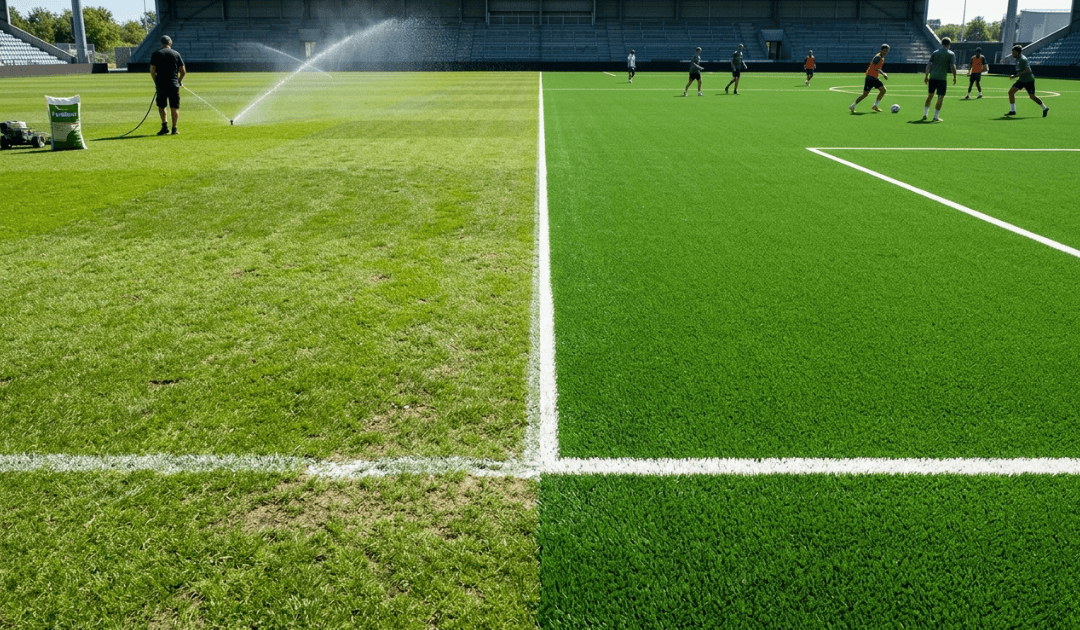
Most public debate about synthetic turf versus natural grass frames it as a binary choice between two fixed categories — as if every synthetic field performs identically, and every grass field performs identically. In practice, the research consistently points somewhere else: field condition and consistency — not surface category alone — is one of the strongest drivers of both playability and safety outcomes. A well-built, well-maintained field of either type outperforms a poorly built or poorly maintained field of the same type. The more useful question for anyone evaluating a surface isn’t “turf or grass,” but “how consistent will this specific field be, play after play, season after season?”
Natural Grass Is Inherently Variable by Nature
Natural grass is a living system, and that’s both its appeal and its central operational challenge. Grass fields change with weather, season, temperature, and moisture. High-traffic zones — center of the field, in front of goals, the hash marks — wear down faster than the rest of the surface under repeated use, creating exactly the kind of uneven footing and inconsistent traction that increases injury risk. A grass field can play firm and predictable in April and be a soft, uneven mess in a rainy November, without a single change to the surface itself. None of this is a flaw unique to any particular grass field — it’s the nature of a living surface, and it’s precisely why grass field quality varies so widely by budget, climate, and groundskeeping resources.
What Engineered Consistency Actually Looks Like
A well-built synthetic system is designed to solve for the variable that grass can’t control: uniformity. That shows up in several measurable ways:
- Consistent Gmax across the entire field. Not just at a single test point, but from sideline to sideline and end zone to end zone.
- Uniform infill depth and distribution. Infill that migrates, compacts unevenly, or thins out in high-traffic areas creates the same kind of inconsistent footing that plagues worn grass, which is why infill consistency is one of the categories evaluated under emerging professional-level testing standards.
- Stable vertical deformation and shock absorption. A field that plays the same in the areas used most (goal mouths, hash marks) as it does in the areas used least.
- Weather-independent performance. A properly drained synthetic system plays similarly whether it rained an hour ago or not, removing one of the largest variability factors in natural grass.
None of this happens automatically just because a surface is labeled “synthetic turf.” It’s a function of system design, installation quality, and infill specification, the same engineering categories covered throughout this Research and Technical Metrics library.
Why a Single Test Result Isn’t the Full Picture
Installation-day testing is necessary, but it’s a snapshot, it tells you how a field performs on day one, under ideal conditions. It doesn’t tell you how that field will perform after 6 months of heavy use, two seasons of weather exposure, or inconsistent maintenance. This is true of both surface types: a grass field can pass every quality standard at seeding and still degrade unevenly by mid-season; a synthetic field can test perfectly at installation and still develop inconsistent infill distribution or matting in high-traffic zones without a proper maintenance program.
This is why Act Global treats consistency as a lifecycle question, not just an installation-day one, covered in more depth in our companion article on maintenance and lifecycle field safety.
What Field Owners Should Actually Ask
Rather than asking “is turf safer than grass,” field owners are better served asking questions that get at consistency directly:
- Is performance data available across multiple points on the field, not just a single test location?
- What infill and maintenance program is required to preserve consistency over the system’s lifecycle, and is that program realistic given our budget and staff?
- How does this system’s performance hold up under our specific climate and usage volume?
- What does re-testing look like after year one, three, and five, not just at installation?
Frequently Asked Questions
Is synthetic turf always more consistent than natural grass?
Only if it’s properly designed, installed, and maintained. Consistency is a function of system quality and upkeep, not something that comes automatically with the material choice, a poorly maintained synthetic field can develop the same kind of uneven, inconsistent footing that affects worn natural grass.
Why does natural grass wear unevenly?
High-traffic areas of a grass field, like goal mouths and hash marks, experience more repeated stress than the rest of the surface, causing faster wear in those zones. Weather, season, and moisture also change how a grass field plays over time, independent of usage.
Does a single installation-day test guarantee long-term field consistency?
No. Installation testing shows how a field performs on day one. Long-term consistency depends on ongoing maintenance and periodic re-testing, for both synthetic and natural surfaces.
What should I ask a turf provider about consistency?
Ask for performance data from multiple points across the field (not a single test location), the maintenance program required to preserve that performance, and how the system is expected to perform under your specific climate and usage volume.
Related Resources
Bringing Science to the Surface™ — Act Global
by Vincent Garcia
“NFL-Ready” Isn’t a Single Credential – It’s a Set of Measurable Standards
Field owners outside the NFL often ask for “NFL-level turf” as shorthand for the highest quality bar available. But NFL suitability isn’t a single stamp of approval a manufacturer either has or doesn’t have, it’s a combination of specific, measurable performance properties, evaluated through defined testing methods. Understanding what those properties actually are is more useful than looking for a single label, especially since the standards themselves continue to evolve as the league and players’ association refine what they measure.
The NFL and NFLPA Are Actively Raising the Bar
In December 2025, the NFL and the NFL Players Association’s Joint Field Surface Safety and Performance Committee introduced new mandatory playing surface standards, applying to both synthetic and natural grass fields. The standards evaluate surfaces using two purpose-built testing tools: the BEAST (Biomechanical Elite Athlete Shoe-Turf Tester), which simulates player movement to assess traction and rotational behavior, and the STRIKE Impact Tester, which measures how much energy a surface absorbs on contact. Systems are tested against a target range informed by natural grass performance data, with the goal of improving consistency across every NFL field, grass, synthetic, or hybrid.
All 32 teams will be required to use an approved surface by the 2028 season. This is a significant, active shift in how the league defines field quality, and it reflects years of player feedback about inconsistent surface performance across venues.
The Core Performance Metrics Behind Any NFL-Level System
Regardless of which specific testing program a field is evaluated under, the underlying properties that separate a professional-grade turf system from a basic one are consistent:
- Traction and rotational resistance. How predictably the surface releases a cleat during cutting and pivoting movements. Too little release increases lower-extremity injury risk; too much reduces performance.
- Impact attenuation (force reduction and Head Injury Criterion). How much energy the surface absorbs versus returns to the body on contact, whether from a fall, tackle, or footstrike.
- Surface consistency (g-max and vertical deformation). How uniform the surface plays across the entire field, not just at a single test point. Inconsistency between the numbers and the sidelines, or between a field’s center and edges, is one of the most common player complaints.
- Infill consistency. Even distribution and depth of infill across the field, which directly affects how uniformly the surface performs from one location to the next.
Act Global tests every system against these categories through independent labs, including Firefly Sports Testing, Labosport, and Sports Labs, the same class of accredited testing infrastructure referenced throughout this Research Library.
What Players Actually Say – and Why It Matters
Any honest discussion of NFL-level turf has to include the NFLPA’s own player survey data: in the union’s most recent membership survey of roughly 1,700 professional players, 92% said they prefer playing on high-quality natural grass, with only 2% preferring synthetic turf.
We’ve written a full breakdown of what that survey does and doesn’t tell us in What the NFLPA Survey Results Really Mean for Field Safety. The short version: that number reflects a preference and comfort metric, not a direct injury-rate metric, and it points to real, historical inconsistency in how synthetic turf has been built and maintained across the league – not proof that a well-engineered synthetic system can’t close that gap. It’s also exactly the kind of data point a serious turf manufacturer should engage with directly rather than avoid.
What This Means for Fields Outside the NFL
Most organizations building a field aren’t installing an NFL stadium surface, but the same underlying categories apply at any level: traction consistency, impact attenuation, surface uniformity, and infill consistency are what separate a well-engineered system from a generic one, whether it’s a high school stadium or a professional practice facility. Field owners evaluating a synthetic turf project should ask for independent test data in these specific categories, not just a general safety claim, regardless of which manufacturer they’re considering.
Frequently Asked Questions
Is there an official “NFL-certified” turf program?
As of December 2025, the NFL and NFLPA introduced new mandatory playing surface standards evaluated by a Joint Field Surface Safety and Performance Committee, using dedicated traction (BEAST) and impact (STRIKE) testing tools. All NFL stadiums and practice facilities must use an approved surface by the 2028 season. This is a newly established, evolving program.
What does the NFL actually test for in a playing surface?
The current framework evaluates traction and rotational behavior, impact energy absorption, and surface consistency, benchmarked against natural grass performance data.
Do NFL players prefer grass or turf?
In the NFLPA’s most recent survey of approximately 1,700 players, 92% said they prefer natural grass, 6% were indifferent, and 2% preferred synthetic turf.
Does that mean synthetic turf is inherently unsafe for professional play?
No, player preference and documented injury risk are related but distinct questions. The survey reflects comfort and preference; it does not, on its own, establish that well-engineered modern turf systems carry higher injury rates than natural grass across the board. See our full review of the NFLPA survey data for more detail.
What should a non-NFL field owner look for if they want “NFL-level” quality?
Independent test data on traction/rotational resistance, impact attenuation (g-max, HIC, force reduction), surface consistency, and infill consistency, the same underlying categories the NFL evaluates, regardless of the specific certification program involved.
Related Resources
Bringing Science to the Surface™ – Act Global
by Vincent Garcia
Why Surface Heat Is a Legitimate Question, Not Just a Perception
Anyone who has walked across a synthetic turf field barefoot on a sunny afternoon already knows the answer to “does turf get hot?” What’s less well understood is how much hotter, why, what actually varies it, and the question that matters most for field owners, what can be done about it. This article breaks down what the current research actually establishes, in plain terms, without overstating or understating what’s known.
Why Synthetic Turf Runs Hotter Than Natural Grass
Natural grass cools itself through evapotranspiration, plants continuously release water vapor, which pulls heat away from the surface, similar to how sweat cools skin. Synthetic turf fibers and infill don’t have this built-in cooling mechanism. Instead, the surface absorbs solar radiation directly and re-radiates it as heat, the same basic physical process that makes asphalt and dark pavement hot in direct sun.
How much heat builds up, and how fast it dissipates, depends heavily on the specific system: fiber color and material, infill type, the presence and design of a shock pad, and how much of the surface is directly exposed to sunlight versus shade.
How Much Hotter, Really?
Surface Temperature
A 2024 systematic review in the International Journal of Biometeorology, the most comprehensive analysis of this question to date, found that synthetic turf surface temperature was consistently higher than natural grass across the studies reviewed, with differences ranging from roughly 9°C to 34°C (about 16°F to 61°F) in direct sunlight, depending on the specific systems and conditions studied. This is a real, well-established, and significant difference.
Air Temperature – A Much Smaller Difference
Here’s where it gets more nuanced: air temperature measured just above the surface, the air athletes are actually breathing and moving through, was also consistently higher over synthetic turf, but by a far smaller margin: roughly 0.5°C to 1.2°C (about 1°F to 2°F) according to the same review. Surface temperature and air temperature are not the same measurement, and the gap between them is one of the most commonly misunderstood parts of this topic. A hot-to-the-touch surface does not automatically mean the surrounding air an athlete is exercising in is dramatically hotter.
What Affects How Hot a Field Gets
- Infill type: Research comparing infill systems has found that fields using standard rubber (SBR) infill or a standard shock pad tend to run hotter than fields using thermoplastic elastomer (TPE) infill or cool-climate fiber technologies, which have been shown to reduce surface temperature measurably in controlled studies.
- Fiber and system design: Fiber color, density, and backing material all influence how much solar radiation a system absorbs versus reflects.
- Sun exposure and climate: Direct, unshaded sun in hot, dry climates produces the highest surface temperatures; cloud cover, shade structures, and cooler ambient conditions all reduce it.
- Time of day and season: Surface temperature tracks closely with solar radiation intensity, not just air temperature, meaning a field can still run hot on a cooler day with intense direct sun, and conversely cool quickly once direct sun exposure ends.
What Field Owners Can Do About It
Surface heat is a design and management problem with real, tested solutions — not something field owners have to simply accept:
- Infill and fiber selection. Choosing cooling-oriented infill and fiber technologies at the design stage can measurably reduce peak surface temperature compared to standard systems.
- Irrigation. Applying water to a synthetic surface produces a real, immediate cooling effect through evaporation, though research also shows the effect is temporary; surface temperature typically rebounds within 20–30 minutes as the water evaporates, so irrigation works best as a pre-game or scheduled cooling strategy, not a one-time fix.
- Emerging cooling system technology. Research groups in the Netherlands have tested subsurface rainwater storage systems that continuously wick water up through the turf backing for evaporative cooling. In one 2024 field study during a June heatwave, a self-cooling turf plot reached a surface temperature of 37°C, compared to 62.5°C for conventional turf tested under the same conditions on the same day, nearly matching the natural grass control plot. This kind of system illustrates how much headroom exists in surface design specifically for heat management, even if it isn’t yet standard across the industry.
- Scheduling and heat policy. Adjusting practice and play times to avoid peak solar radiation hours, combined with standard heat-illness prevention protocols (hydration breaks, monitoring, acclimatization periods), remains one of the most effective and immediately available mitigation tools regardless of surface type.
What We Still Need to Learn
Here’s the honest, unresolved part of this topic: researchers have established that synthetic turf surface temperature runs measurably higher than natural grass. What research has not yet established is whether that surface temperature difference, as distinct from air temperature, radiant heat, humidity, and wind, which make up the fuller thermal environment, translates into a meaningfully higher heat stress risk for athletes. The 2024 systematic review referenced above is explicit that this remains an open question requiring further study, not a settled one.
We think field owners are better served by that honest uncertainty than by a confident claim in either direction. Surface heat is real and worth designing around, that much is established. Whether it constitutes a proven, elevated athlete safety risk on its own, beyond appropriate heat-policy precautions already used on any outdoor playing surface, is not yet something the research settles.
Frequently Asked Questions
Does synthetic turf really get hotter than natural grass?
Yes. Research consistently shows synthetic turf surface temperature runs significantly higher than natural grass in direct sunlight, typically by 9°C to 34°C (16°F to 61°F) depending on the system and conditions.
Is the air above synthetic turf also much hotter?
Only slightly. Air temperature just above the surface is typically 0.5°C to 1.2°C (1°F to 2°F) higher than over natural grass, a much smaller difference than the surface temperature gap.
Does watering a synthetic turf field actually cool it down?
Yes, temporarily. Irrigation produces a real cooling effect through evaporation, but surface temperature typically rebounds within 20 – 30 minutes, so it works best as a scheduled strategy before games or practices rather than a one-time solution.
Can infill choice reduce how hot a field gets?
Yes. Studies comparing infill types have found that TPE infill and cool-climate fiber technologies run measurably cooler than standard rubber (SBR) infill systems under the same conditions.
Does higher surface temperature mean higher heat stress risk for athletes?
This remains an open research question. Surface temperature is well-documented as higher on synthetic turf, but researchers have not yet established whether that specific difference translates into meaningfully greater heat stress risk once the full thermal environment, air temperature, radiant heat, humidity, and wind, is accounted for.
Related Resources
Bringing Science to the Surface™, Act Global